
Reviewed · LUCERNE & LAKE LUCERNE
Private Classic Lucerne City Walk
Lucerne clicks fast when you see the story in order. This private classic city walk is built for your group only, with easy pickup from your Lucerne hotel and a route that hits the Old Town big hitters without fuss. I especially like the hotel pickup (no hunting for meeting points) and the way your visit to Ritterscher Palace is handled with prebooked entry when it’s open.
My other favorite part is the up-close feel of the city’s defenses at Musegg Wall, including a climb to the Clock Tower for wide views. One consideration: depending on the day and season, two major indoor/paid-feeling stops turn into outside-only views—Ritterscher Palace closes on Saturdays, Sundays, holidays, and special events, and the Musegg Wall and towers close from November to March.
In This Review
- Key highlights you’ll feel right away
- Private Lucerne City Walk: what you really get in 2 hours
- Hotel pickup and the easiest start in Lucerne
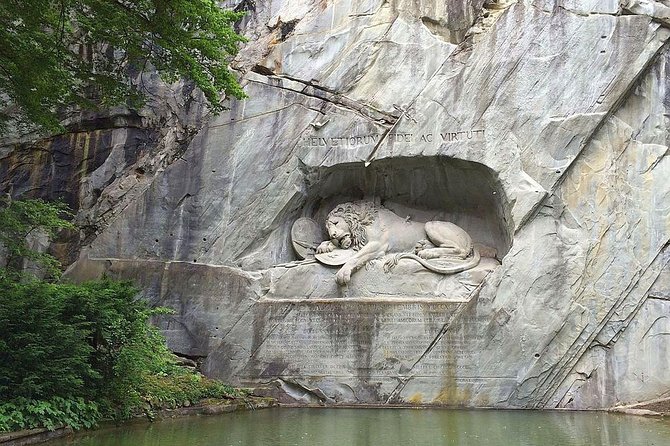
- Bourbaki Panorama and Lion Monument: memorials with context
- Musegg Wall towers: the climb that earns the views
- Hirschenplatz and Kornmarkt: Old Town squares with real street stories
- Reussbrücke and the riverside angles you’ll want to return to
- Ritterscher Palace and the Danse Macabre panels
- Jesuit Church Lucerne: early Swiss Baroque, with an active schedule
- Chapel Bridge and the Water Tower: why it’s more than a photo stop
- Peterskapelle and Rosengart Platz: closing the loop on Chapel Bridge
- Price and value: what $198 buys you in Lucerne
- Who this tour is best for (and who should consider other options)
- Should you book Private Classic Lucerne City Walk?
- FAQ
- How long is the Private Classic Lucerne City Walk?
- What does it cost?
- Is this tour private or shared?
- Do you pick up guests from their hotel?
- Is public transportation included?
- Are admission tickets included?
- What happens if I visit on a weekend or holiday?
- Are the Musegg Wall and towers open in winter?
Key highlights you’ll feel right away
- Hotel pickup in Lucerne city limits or at the main station arch so you start walking stress-free
- A tight 2-hour route with short stops that still cover real meaning, not just landmarks
- Musegg Wall towers and defense walk with an uphill climb and a view from the Clock Tower area
- Ritterscher Palace Danse Macabre and the Jakob von Wyl painting gallery (outside-only on closed days)
- Old Town squares like Hirschenplatz and Kornmarkt with details that explain the street “why”
- A local guide who can fine-tune timing (one guide, Ralf, is noted for adjusting to guests’ plans)
More runs down to Lucerne and its lake
- From Zurich: Mount Titlis and Lucerne Day Tour★ 4.7 · 3,381 reviews
- Lucerne: Mt. Pilatus Cable Car, Cogwheel Train & Lake Cruise★ 4.7 · 2,338 reviews
- Lucerne: 1-Hour Cruise on Panoramic Yacht★ 4.6 · 1,514 reviews
- Mount Pilatus Summit from Lucerne With Lake Cruise★ 4.5 · 1,260 reviews
Private Lucerne City Walk: what you really get in 2 hours
This is the kind of tour that makes sense on day one. You get a guided path through Lucerne’s postcard-famous sights, but the pacing stays practical: quick introductions, then you move on before the city gets too crowded around you.
The format also helps you make smart follow-ups. After this, you’ll know where to return for a longer look—whether that’s the bridge area, the old squares, or the views from the fortifications.
And because it’s private, you’re not stuck waiting for a slow group or rushing past the parts you care about. Your guide keeps the route moving at a steady walking pace, with time for questions.
Hotel pickup and the easiest start in Lucerne
One of the biggest wins here is simply how you meet. You’re picked up from any hotel within Lucerne’s city limits, or you can meet at the big arch by Lucerne main station. There’s also an option to advise your pickup place later, which helps if you’re still figuring out logistics.
If you’re staying at a Lucerne hotel, you’ll also deal with transit in a smarter way. You’re given a Visitor Card at reception, and it entitles you to free public transportation during your stay. That matters because part of the route uses a bus when you start at your hotel and head toward Lion Square.
In plain terms: you spend more time seeing Lucerne and less time doing mini scavenger hunts.
Bourbaki Panorama and Lion Monument: memorials with context
The tour starts with a short walk (or bus ride) toward Lion Square, then the first stop is the Bourbaki Panorama area. You’ll see the Bourbaki Museum from the outside and get the story behind it. Even as an exterior stop, it sets a tone. You’re not just collecting scenery—you’re learning why this city remembers what it remembers.
Next comes the Lion Monument, one of Lucerne’s most famous memorials. Here the guide explains the Swiss Guards during the French Revolution. You’ll hear how Swiss guards served many rulers across Europe, then how events in 1789 led to the attack on the French King’s palace and the deaths of about 800 Swiss guards.
Why this works on a short city walk: it gives you a mental map. When you later see Lucerne’s symbols and fortifications, you’ll understand what the city is trying to communicate.
Tip for your visit: stand back for a moment. The Lion Monument is visually striking, but the best effect comes after the story lands.
Musegg Wall towers: the climb that earns the views
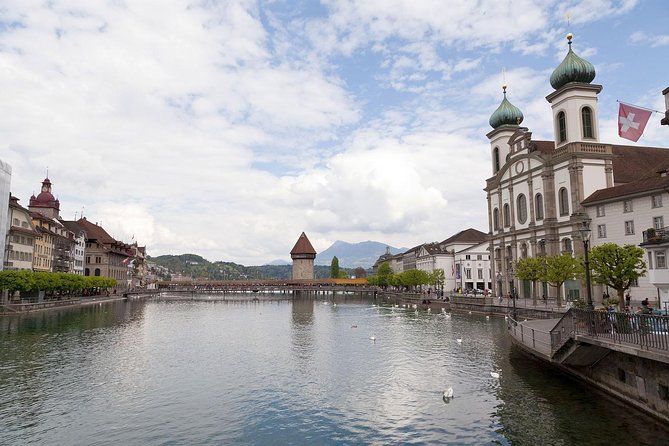
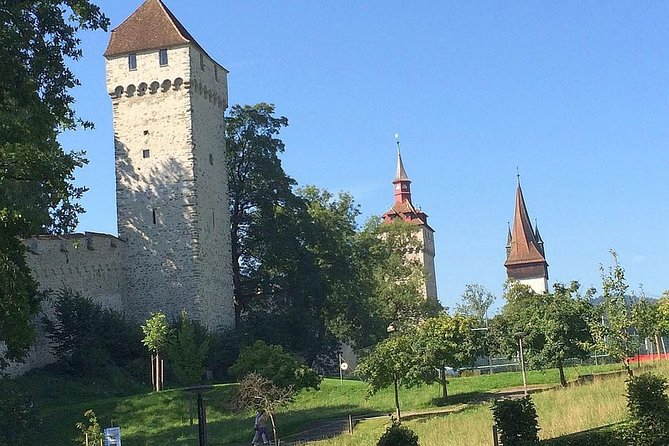
This is where the tour turns from “pretty” to “wow, I get it now.” After a leisurely uphill walk, you reach the Musegg hill and visit two sections of the Musegg Wall and towers. You then climb Schirmertower, walk along the defense walk, and head up to the Clock Tower top area.
The key detail is the age and purpose. You’re looking at fortifications dating back to the early 15th century. You can feel how the design was built for defense, then still imagine daily life around a walled city.
There’s also a practical payoff: the viewpoint. You’ll get a look out over the city, the Alps, and the midland areas beyond. In a two-hour tour, this is your biggest “stretch your neck and take it in” moment.
Two season notes to plan around:
- From November to March, the Musegg Wall and towers are closed. You can view them from the outside only.
- On any season, expect an uphill stretch and steps as part of the tower climb.
Keep wandering the lanes of the Old Town


Hirschenplatz and Kornmarkt: Old Town squares with real street stories
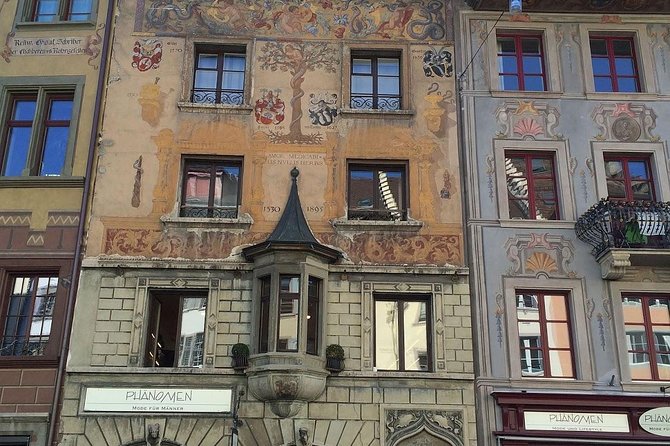
After the fortifications, you move into the core of Old Town. At Hirschenplatz (Stag Square), you’ll see medieval houses with facade paintings. This isn’t a generic “take a photo” stop; the guide helps you connect the art and architecture to how the city developed and branded itself.
Then you head to Kornmarkt, the Town Hall Square, where the Town Hall and Tower date back to the early 17th century. You learn about the clock, including its unusual design that does without a minute hand. It’s the kind of detail that makes you look at the tower again later, even after the tour.
From there you continue to Weinmarkt, which was once called the Fish Market. This stop also includes a taste: you’ll learn why Lucerne’s old city fountains are prized for their spring water, then you’ll taste it at the oldest fountain in the city.
Why I like this part of the walk: it shows you that Lucerne’s charm is not only in big monuments. It’s in the daily stuff—water, squares, and how public buildings worked.
Reussbrücke and the riverside angles you’ll want to return to
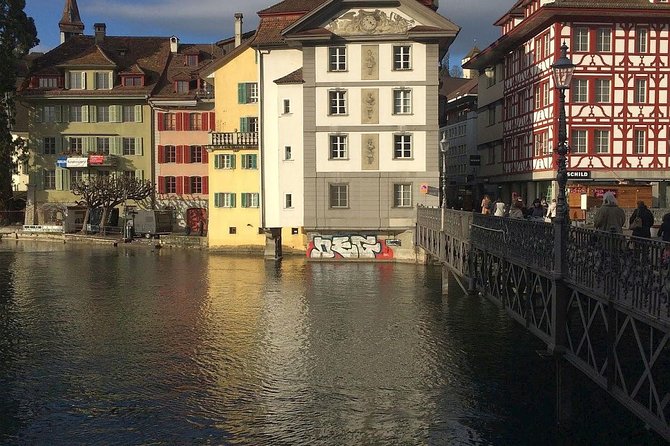
You pass by the lower Wine Market, where a pillory once stood. Then it’s across the Reuss Bridge (Reussbruecke). From here, the guide points out the river Reuss, the needle dam, and the mill bridge (Spreuerbruecke), plus two of the Musegg towers visible from the riverside.
This stretch helps you understand Lucerne’s layout. The river cuts through the city, and suddenly the old wall, the bridge network, and the towers feel connected instead of like separate stops.
If you’re the type who likes to wander after a tour, this is a good place to note where you want to linger. The riverside views are where your next walk will probably start.
Ritterscher Palace and the Danse Macabre panels
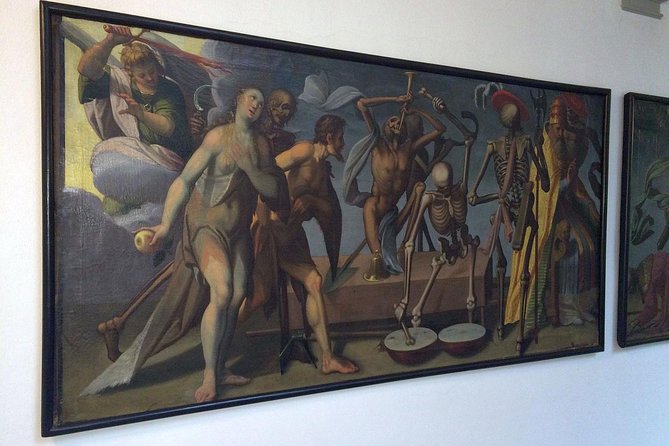
Ritterscher Palace Lucerne is the tour’s main indoor highlight. You get an inside visit to the 16th-century Florentine Palazzo, guided through the Danse Macabre gallery—a set of seven paintings by Jakob von Wyl.
This stop can feel like a different kind of Lucerne. You’ve been outside with towers and bridges; now you’re inside with art that carries a heavy theme. That contrast is part of the value. It keeps the two-hour tour from feeling one-note.
Important timing note: the palace is closed on Saturdays, Sundays, holidays, and special events. On those days, you’ll view it from the outside only.
If you’re booking specifically for the paintings, plan your day accordingly. If you’re visiting on a closed day, ask your guide what nearby alternatives work best for your interests.
Jesuit Church Lucerne: early Swiss Baroque, with an active schedule
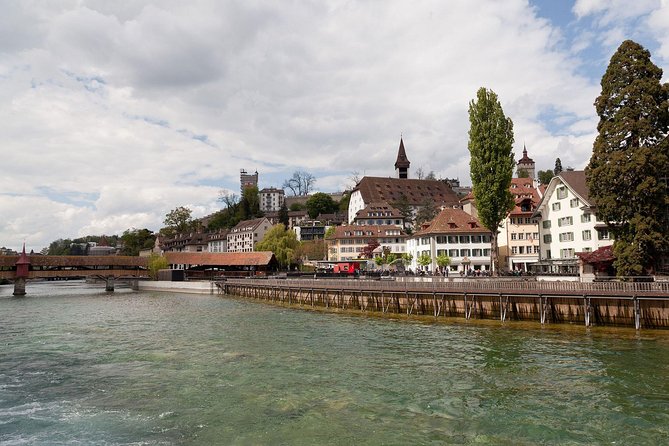
Next is the Jesuit Church Lucerne, the first Baroque church in Switzerland. The guide explains the story behind it, and then you have the possibility to enter and see it from the inside.
There’s one limitation: inside access can be restricted during mass services. That doesn’t mean you’re out of luck—it means the guide will adapt to what’s allowed at the time you arrive.
This is a good stop if you want Lucerne’s history to include religion and art, not only civic monuments. The church also fits the rhythm of the route: you just finished a palace interior, and you’re now stepping into a different kind of interior space.
Chapel Bridge and the Water Tower: why it’s more than a photo stop
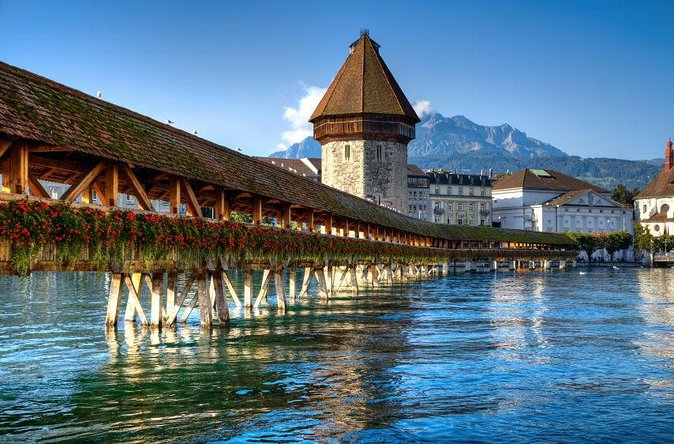
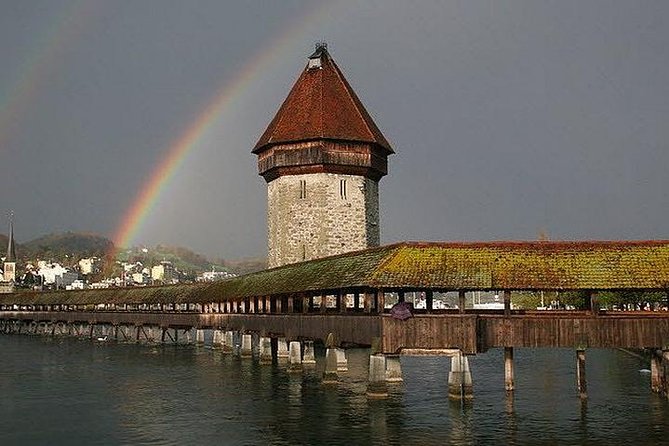
You’ll walk to Chapel Bridge (Kapellbruecke) with its Water Tower. You’ll hear the details about how the bridge used to function as part of the city’s fortifications, including how the paintings and the Water Tower relate to that older defense role.
The Water Tower once acted as a prison. That’s a detail you’ll remember the next time you see the bridge in daylight postcard shots. It changes the vibe from romantic to historical instantly.
The stop continues with the flow into the final area near St. Peter’s Chapel, so it works as a climax rather than a standalone moment.
Peterskapelle and Rosengart Platz: closing the loop on Chapel Bridge
The tour ends near Rosengart Platz by St. Peters Chapel, the first church in town dating back to the 12th century. You’ll also see Zur Gilgen House, described as the first private stone house in Lucerne from the early 16th century.
Then the guide ties it together. You’ll learn why Chapel Bridge is called Chapel Bridge, and that short explanation brings closure to the route you’ve been walking.
Afterward, your guide brings you back to your hotel by public transportation or on foot.
If you like structure in your sightseeing, this ending helps. You don’t just stop at random. You finish with a reason.
Price and value: what $198 buys you in Lucerne
At $198 per person for a private 2-hour walk, the price is not “cheap,” but it is easy to justify when you look at what you’re getting.
You’re paying for:
- a professional local guide who moves you efficiently between Old Town and higher viewpoints,
- hotel pickup and drop-off within city limits (or a station pickup alternative),
- prebooked Ritter Palace admission where it’s open,
- and a route where the listed admission tickets are free for the stops included.
You’re also getting small extras that add up when you like souvenirs without overpaying: three exclusive postcards featuring Old Lucerne.
Where the money can feel less worth it is if you’re the type who already knows Lucerne well and would rather self-tour with no guidance. But if you want your time to count—especially on a first or second day—this private format helps you see more with less guesswork.
Also, timing matters. In a short city like Lucerne, “lost time” is real time. Pickup and clear routing prevent that.
Who this tour is best for (and who should consider other options)
This tour is a strong match if you:
- want a first introduction to Lucerne without spending hours planning,
- like history explained in a way that connects places to events,
- and want both postcard sights and “how this city worked” context.
It’s also a good fit for families and mixed ages because many stops are short and there’s an easy walking rhythm. The one physical note is the uphill walk to Musegg hill and the tower climb. If mobility is a big issue, you’ll want to discuss your needs with the provider before booking.
Should you book Private Classic Lucerne City Walk?
I’d book it if you want a smart Lucerne orientation with a guide who helps you connect the dots—bridge, towers, squares, and art—within a compact schedule. The hotel pickup alone saves enough energy to make the rest feel effortless.
I’d think twice if your trip falls on a Saturday, Sunday, holiday, or special event and you’re specifically aiming to see Ritter Palace interiors, since it may be outside-only. I’d also adjust expectations for November through March if Musegg Wall and towers are closed, because you’ll only view them from outside.
If you’re flexible and want the cleanest path through Old Town, this private walk is one of the easiest ways to start enjoying Lucerne right away.
FAQ
How long is the Private Classic Lucerne City Walk?
It runs about 2 hours.
What does it cost?
The price is $198.00 per person.
Is this tour private or shared?
It’s private, meaning only your group participates.
Do you pick up guests from their hotel?
Yes. Pickup is offered from any hotel within Lucerne city limits, or at the big arch right at Lucerne main station.
Is public transportation included?
A public transportation ticket is not included if applicable. If you stay in a Lucerne hotel, you can use the Visitor Card from your hotel reception for free public transportation during your stay.
Are admission tickets included?
For the stops listed in the route, admission tickets are marked free. Ritter Palace has prebooked admission when it’s open.
What happens if I visit on a weekend or holiday?
Ritterscher Palace can be closed on Saturdays, Sundays, holidays, and special events. On those days, it can be visited from the outside only.
Are the Musegg Wall and towers open in winter?
From November to March, the Musegg Wall and towers are closed and can be visited from the outside only.
More Tour Reviews in Lucerne
- From Zurich: Mount Titlis and Lucerne Day Tour★ 4.7 · 3,381 reviews
- Lucerne: Mt. Pilatus Cable Car, Cogwheel Train & Lake Cruise★ 4.7 · 2,338 reviews
- Lucerne: 1-Hour Cruise on Panoramic Yacht★ 4.6 · 1,514 reviews
- Mount Pilatus Summit from Lucerne With Lake Cruise★ 4.5 · 1,260 reviews
- Lucerne: Round-Trip Catamaran Cruise on Lake Lucerne★ 4.4 · 1,169 reviews
More of the Old Town on Foot
- Lucerne: eTukTuk City Tour★ 4.9 · 268 reviews
- Official Guided City Tour of Lucerne★ 4.5 · 141 reviews
- City Tour Plus Lucerne by Etuktuk★ 5.0 · 120 reviews
- Tony`s private city tour with picnic & chocolate degustation★ 5.0 · 80 reviews
- Chocolate Tasting with Lake Trip and City Tour: The Ultimate Lucerne Experience★ 5.0 · 22 reviews
Down to Lucerne, Again
- From Zurich: Mount Titlis and Lucerne Day Tour★ 4.7 · 3,381 reviews
- Lucerne: Mt. Pilatus Cable Car, Cogwheel Train & Lake Cruise★ 4.7 · 2,338 reviews
- Lucerne: 1-Hour Cruise on Panoramic Yacht★ 4.6 · 1,514 reviews
- Mount Pilatus Summit from Lucerne With Lake Cruise★ 4.5 · 1,260 reviews
- Lucerne: Round-Trip Catamaran Cruise on Lake Lucerne★ 4.4 · 1,169 reviews
Hot Off the Rails: Our Newest Zurich and Alpine Reviews
- Luzern Elegance: Private City Walk and Panoramic Lake Cruise
★ 5.0 · 3 reviews - Lucerne: Legends of Lake Lucerne – Steamboat Experience
★ 5.0 · 3 reviews - Lucerne: Glacier Express’s Swiss Alps & Lucerne Private Tour
★ 5.0 · 3 reviews - Lucerne Lakeside and Villas Private Walking Tour
★ 5.0 · 3 reviews - Lucerne: Private Walking Tour and Chocolate Tasting
★ 5.0 · 3 reviews
Lucerne & Lake Lucerne, compared.
 ★ 4.7Mount Titlis and Lucerne Day TourFrom $2143,381 reviews
 ★ 4.7Mt. Pilatus Cable Car, Cogwheel Train & Lake CruiseFrom $2122,338 reviews
 ★ 4.5Mount Titlis and Lucerne Day Trip from ZurichFrom $2151,960 reviews
 ★ 4.61-Hour Cruise on Panoramic YachtFrom $391,514 reviews
 ★ 4.5Mount Pilatus Summit from Lucerne With Lake CruiseFrom $2231,260 reviews
 ★ 4.4Round-Trip Catamaran Cruise on Lake Lucerne1,169 reviews
 ★ 4.7Mt. Pilatus Gondola, Cable Car, and Boat TripFrom $1411,143 reviews
 ★ 4.8Lucerne & Mount Pilatus Day TourFrom $2381,110 reviews
Browse the lists this tour appears in