
Reviewed · ZURICH OLD TOWN WALKS
Self-Guided Audio City Tour in Zurich
Zurich is even easier with stories in your ears. This self-guided audio route stitches together politics, art, science, and religion as you walk between iconic landmarks like Grossmünster and Fraumünster. I liked how the narration gives real context instead of just pointing at buildings, and I also liked the practical, photo-supported directions that keep you moving. The main catch: you’re relying on your phone’s internet and battery, and the audio can hiccup if the connection is shaky.
Start and end in the best place for a stroll. You begin at Bahnhofplatz by the Alfred Escher-Denkmal and finish near Max Bill’s Pavilion-Skulptur, so it feels like a loop through the city center rather than a one-way chore. One potential drawback is that the total time can stretch past the 2 to 3 hour promise if you stop to read, look closely, or linger inside churches.
In This Review
- Key highlights you’ll feel right away
- Zurich in audio: why this route works
- Bahnhofplatz to Alfred Escher: the business-and-rail origin story
- Pestalozzianlage and Urania: education and the sky
- Lindenhof Hill: panoramic views with a side of quiet unease
- St. Peter’s Church clock and the Roman street traces
- Cabaret Voltaire and the Lenin Apartment: two kinds of rebellion
- Grossmünster and Wasserkirche: stained glass with names you’ll remember
- Monuments, Zwingli, and the opera facade
- Weinplatz guild building and Paradeplatz’s city-center energy
- Hans Waldmann statue, Augustinerkirche, and a final creative signature
- Fraumünster interior: when CHF 5 is worth it
- How long it really takes, and how to pace without rushing
- Value: what you’re really paying for at $13.29
- Who this suits best
- Should you book this Zurich audio city tour?
- FAQ
- Is this tour self-guided or does it include a live guide
- What language is the audio guide in
- How long does the tour take
- Do I need internet and a headset on my phone
- Where do I start and where does it end
- Are any of the stops free to enter
- What if I want to go inside Fraumünster
- Is the tour private
Key highlights you’ll feel right away
- Self-paced walking through major Zurich sights without waiting for a group
- Clear phone directions with photos, so you’re not guessing street corners
- Top-notch audio storytelling that adds meaning to places like Cabaret Voltaire and the Lenin Apartment
- Big variety in small time: Roman baths, stained glass, monuments, guild buildings, and opera architecture
- A thoughtful ending at Max Bill’s Pavilion-Skulptur, right on Bahnhofstrasse
- Optional paid add-on: you may pay CHF 5 for Fraumünster interior
Keep wandering the lanes of the Old Town
- Zurich: City Tour, Cruise, and Lindt Home of Chocolate Visit★ 4.5 · 4,624 reviews
- Zurich: City Highlights Tour by Bus, Cable Car, and Ferry★ 4.4 · 2,366 reviews
- Best of Zurich Tour with Felsenegg Cable Car and Ferry Ride★ 4.0 · 1,229 reviews
- Zurich: City Bus Tour with Audio Guide and Lake Cruise★ 4.3 · 1,195 reviews
Zurich in audio: why this route works

Zurich’s center is compact, walkable, and made for “slow looking.” What makes this tour good is that it nudges you to notice details you’d otherwise gloss over: why a statue matters, what a church clock is telling you, and how Zurich became the Zurich you see today.
You’re not just doing sightseeing checkmarks. You’re following a narrative line that moves from Swiss industry and education (Alfred Escher and Pestalozzi) to faith and reform (St. Peter, Grossmünster, Zwingli) and then into modern ideas and disruption (Cabaret Voltaire, Lenin’s exile). Even better, many stops are free to view, so your money goes into the audio experience rather than entrance fees.
The practical side matters too. This is mobile-ticket and audio-guide based, offered in English. There’s no live guide, so you need a working plan: headset, a connected phone, and enough battery to stay smooth.
Bahnhofplatz to Alfred Escher: the business-and-rail origin story
You start right in the action at Bahnhofplatz beside the Alfred Escher-Denkmal (Alfred Escher Statue). This is a great warm-up stop because Alfred Escher isn’t just a name on a plaque. The narration frames him as a major force behind shaping the Swiss economy and the railway system, which is a smart way to understand Zurich’s modern footprint.
From there, you’re set up to look at the city as more than postcard scenes. Escher also trains your eye: monuments here tend to represent decisions, not just individuals. After that, the route becomes a series of “why this spot, why this moment” mini-stories.
If you prefer starting with something meaningful before you hit the view-hunting stage, this works well.
Pestalozzianlage and Urania: education and the sky
Next comes Pestalozzianlage, centered on the Monument to Johann Heinrich Pestalozzi. The point isn’t just to see stone. You get a prompt to reflect on enlightenment and educational change, which makes the surrounding city texture feel less random. This is one of those stops where the story makes the space feel purposeful.
Then you’ll come to a stop for the Urania Observatory, where the wonders of the cosmos are part of what you’re supposed to notice. For many people, Zurich can feel practical and buttoned-up. Urania adds a different flavor: curiosity, science, and a sense that the city thinks beyond its own streets.
A good move here is to slow down for a minute or two. Even if you’re not going inside, it helps to take in the setting while the audio connects the dots.
Lindenhof Hill: panoramic views with a side of quiet unease
At Lindenhof Hill, you get a classic Zurich payoff: views over the city and the Limmat River. You’re also tipped toward specific things to look for, including the narrative behind Hedwig Fountain and the architectural splendor of the Masonic Lodge nearby.
This is also where the tour adds a touch of emotional color. There’s mention of the Tombstone of Lucius Aelius, and that little tone shift matters. It turns the hill from just a viewpoint into a moment where you feel the weight of time under the skyline.
Because this is a hill, it can slow you down even if you’re moving fast. So if you’re trying to keep a tight schedule, treat Lindenhof as your “walk-and-photo” stop, not a “read-everything-and-linger-forever” stop. You’ll want energy later for the churches.
Set your own pace on another self-guided trail


St. Peter’s Church clock and the Roman street traces
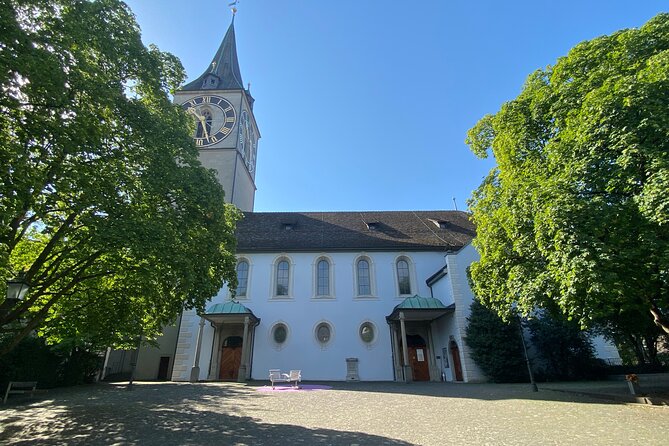
St. Peter’s Church is one of the best “stop and reset your brain” moments in the route. The audio frames it as Zurich’s oldest parish church, and it points out the iconic clock face, noted as one of the largest in Europe. That kind of detail makes you look upward instead of just forward, which is exactly what a self-guided audio walk should do.
Right after that, you’ll walk to Thermengasse, where you’re guided to the remains of ancient Roman baths. This is a big reason the tour feels more than modern-city sightseeing. You’re reminded that Zurich has had people here for a long time, and those traces are in the open in the street pattern and ruins you can see.
Then you’ll move to the Town Hall (Rathaus), tied to Zurich’s political heritage. This combo of St. Peter’s, Roman remains, and Rathaus gives you three lenses at once: faith, daily life long ago, and civic power.
If you don’t love church interiors, you can still enjoy the exterior and the surrounding context. If you do love interiors, keep a bit of time budget here because it’s tempting to slow down.
Cabaret Voltaire and the Lenin Apartment: two kinds of rebellion
The route pivots into modern history with Cabaret Voltaire, described as the birthplace of the Dada movement. The audio ties the space to artists and writers who wanted to challenge convention with provocative, rule-bending ideas. Even if Dada isn’t your personal taste, it helps explain why Zurich became a magnet for new thinking.
Not far away, you’ll reach the Lenin Apartment Zurich, marking the place where Vladimir Lenin stayed during his exile period. This part can feel surreal: one stop is art-as-chaos, the next is political plotting. Put together, the two experiences make you think about ideas traveling through cities, not just through books.
This section is also where the tour’s “you are moving while learning” style really shines. The city is the classroom, and the jumps between topics keep the route from feeling monotonous.
Grossmünster and Wasserkirche: stained glass with names you’ll remember
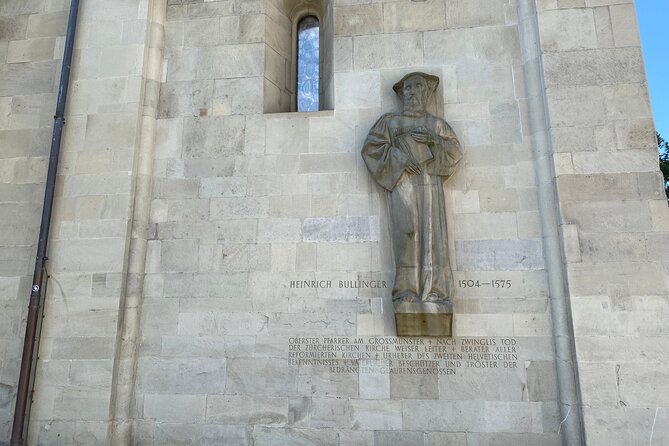
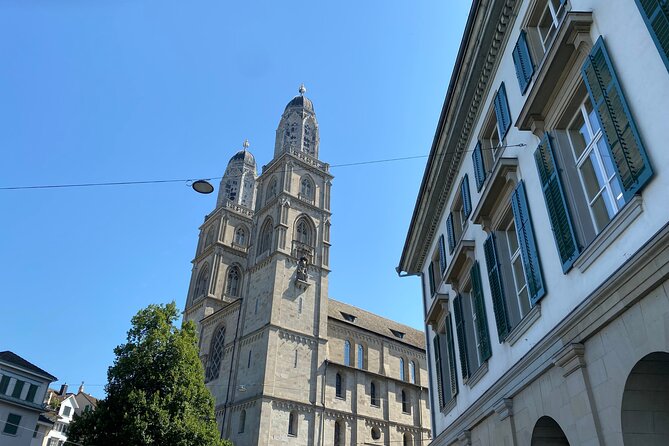
At Grossmünster, you’re meant to notice the twin towers shaping the skyline. The narration also ties the church to the Swiss Reformation and Zurich’s religious turning points. Then there’s the detail that makes many people stop in place: the stained glass windows by Augusto Giacometti. Light on glass can be hard to describe, but the tour gives you something to watch for while you stand there.
Next, Wasserkirche brings another stained-glass story set along the Limmat River. Each window has its own story, so it feels less like looking at one famous artwork and more like reading multiple mini-chapters.
If you want the best results with stained glass stops, do this: stand still for a full minute before you move on, even if you think you already “got it.” Audio helps, but stillness helps more.
Monuments, Zwingli, and the opera facade
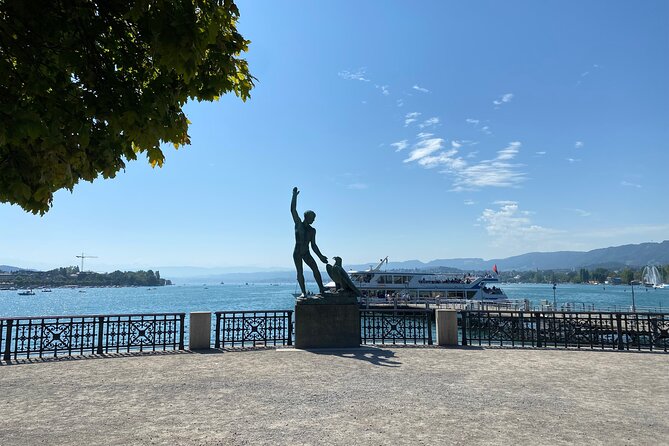
You’ll also pass the Ulrich Zwingli Monument, which honors the reformer tied to shaping the Protestant Reformation. Like Alfred Escher earlier, this is a monument stop that pushes you to interpret rather than just observe. Zurich’s history shows up here through the people it chose to remember.
Then the route takes you to Opernhaus Zürich, the opera house. The facade includes busts of eminent composers and writers, and that detail matters because it shows you Zurich treating culture like civic infrastructure, not a side hobby.
If you like architecture, keep your eyes up when you reach the opera. It’s easy to walk past the building’s “story layer” if you’re only focused on the street level.
Weinplatz guild building and Paradeplatz’s city-center energy
Around Weinplatz, the route points you toward the Millers’ and Bakers’ Guild Building. You’re guided to think about the people who worked behind the scenes that fed and supplied a city, which adds a human scale to the grand monuments.
Then comes Paradeplatz, Zurich’s financial-district heart. This is your “modern Zurich” reset. You’ll feel commerce and motion rather than church quiet. It’s also a useful contrast stop after all the reform and art history.
If you want a quick break, Paradeplatz is a good place to pause, grab a drink, and decide whether you’re continuing at a steady clip or slowing for the last stretch.
Hans Waldmann statue, Augustinerkirche, and a final creative signature
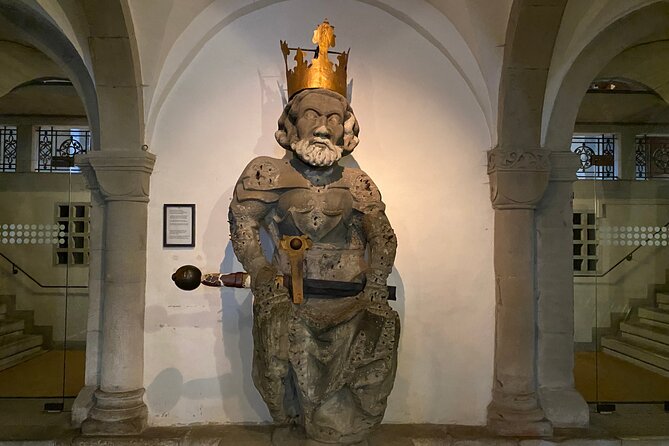
The route includes the Hans Waldmann Statue, tied to a dramatic life story: humble beginnings, rise to burgomaster, and an ending marked by a sentence to death. That’s a heavy topic for a statue on a sunny walk, and the narration helps you feel why the story sticks.
Next is Augustinerkirche, described as humble with a quiet-reflection vibe. It’s a nice counterpoint when your feet are ready for a softer moment.
After that, you’ll reach Pavillon-Skulptur von Max Bill (1983), which is the tour’s finish. The audio frames it as a symbol of transparency, equality, and freedom. It’s a strong last stop because it points forward into ideas, not just back into past events.
Fraumünster interior: when CHF 5 is worth it
You can view Fraumünster from outside for free, and the tour notes that if you want to go inside, there’s an entrance fee of CHF 5 per person (this isn’t included). Fraumünster is famous in part for stained glass windows created by Marc Chagall, and the audio prepares you to look at how the light changes the feel of the space.
This is the one paid add-on that’s clearly spelled out. If you’re budget-minded, you can still enjoy the exterior and move on. If you’re willing to spend a bit for atmosphere, the stained glass focus makes the CHF 5 feel like a targeted choice rather than an extra tax on your day.
How long it really takes, and how to pace without rushing
The tour is described as 2 to 3 hours, but that’s an estimate. In practice, you’ll want to plan for extra time if you:
- stop often for photos,
- listen to every stop fully,
- or spend more time in the churches.
A self-guided tour shines when you set your own pace. Use the short stops (many are around 5 minutes) to keep momentum, and use the longer ones (like Lindenhof Hill and the churches) to decide how deep you want to go.
One tip from experience with audio tours: your phone battery is part of your gear. Bring a charged phone, consider a power bank, and keep your brightness sensible so you don’t burn power while the audio is playing.
Also watch your internet connection. The audio depends on a mobile link, and a shaky connection can cause playback to restart.
Value: what you’re really paying for at $13.29
At $13.29 per person, you’re buying more than a route. You’re paying for:
- high-quality audio by a professional speaker,
- a guided path with photos and directions, and
- storytelling that turns recognizable landmarks into a coherent walk.
Most stops are admission free, which is a big part of the value. The only clearly stated paid interior option is Fraumünster at CHF 5 if you choose to go inside. That keeps your spending predictable.
So the value equation looks like this: relatively low cost + lots of free viewing + a phone-based guide you can pause and restart as you like. If you like your sightseeing with context, this price is easy to justify.
Who this suits best
This tour fits you if you want:
- a first-time Zurich orientation through the historic center,
- control over your pace,
- and an audio format that gives you story context as you walk.
It’s also a good fit if you’re tired after a long travel day. You’re not waiting on anyone else’s pace, and you can step out, stand still, and then keep going when your energy returns.
If you strongly prefer offline audio or you’re often without mobile data, you’ll want to think twice, since the audio depends on your phone having internet.
Should you book this Zurich audio city tour?
Book it if you want an easy, affordable way to connect Zurich’s biggest sights into one walk, especially if you care about why places exist, not just that they exist. It’s also a smart choice if you like the freedom to pause and spend extra time at the Grossmünster or Fraumünster area without paying for a long guided group format.
Skip or plan carefully if your phone battery is usually low or your internet signal isn’t reliable where you’ll be walking. The route is right for a city-center stroll, but the audio experience is only as smooth as your phone setup.
If you’re comfortable traveling with a headset and a connected phone, this is one of the better ways to see Zurich fast and still feel like you learned something.
FAQ
Is this tour self-guided or does it include a live guide
It’s self-guided with no live guide. After booking, you use the link provided to access the audio tour and follow the route on your phone.
What language is the audio guide in
The audio guide is offered in English.
How long does the tour take
It’s listed as about 2 to 3 hours, but you can take longer depending on how much time you spend at stops.
Do I need internet and a headset on my phone
Yes. You need your own mobile phone with internet and a headset to use the audio guide.
Where do I start and where does it end
The tour starts at Bahnhofplatz by the Alfred Escher-Denkmal (8001 Zürich). It ends next to the Pavillon-Skulptur von Max Bill, Bahnhofstrasse 47 (8001 Zürich).
Are any of the stops free to enter
The tour includes many main stops with admission ticket free. Fraumünster interior is the one clearly stated paid option.
What if I want to go inside Fraumünster
If you decide to see Fraumünster from inside, the entrance fee is CHF 5 per person. It is not included in the tour.
Is the tour private
Yes. It’s listed as a private activity, meaning only your group participates.
More Tour Reviews in Zurich
- Lindt Home of Chocolate Museum Entry Ticket★ 4.7 · 9,329 reviews
- Zurich: Day Trip to Grindelwald, Interlaken & Lauterbrunnen★ 4.5 · 4,699 reviews
- Zurich: City Tour, Cruise, and Lindt Home of Chocolate Visit★ 4.5 · 4,624 reviews
- From Zurich: Bus Day Trip to Heidiland and Liechtenstein★ 4.5 · 2,531 reviews
- Zurich: City Highlights Tour by Bus, Cable Car, and Ferry★ 4.4 · 2,366 reviews
More Trails You Set Yourself
- Zurich: City Bus Tour with Audio Guide and Lake Cruise★ 4.3 · 1,195 reviews
- Zurich City Tour with Audio Commentary★ 4.0 · 372 reviews
- Zurich: City Top Attractions Tour by Bus with Audio Guide★ 4.3 · 282 reviews
- The Dark Side of Zurich: Self-Guided Audio City Tour★ 4.4 · 52 reviews
- Zurich: Audio Guided City Tour and Train to “Top of Zurich”★ 4.2 · 41 reviews
More of the Old Town on Foot
- Zurich: City Tour, Cruise, and Lindt Home of Chocolate Visit★ 4.5 · 4,624 reviews
- Zurich: City Highlights Tour by Bus, Cable Car, and Ferry★ 4.4 · 2,366 reviews
- Best of Zurich Tour with Felsenegg Cable Car and Ferry Ride★ 4.0 · 1,229 reviews
- Zurich: City Bus Tour with Audio Guide and Lake Cruise★ 4.3 · 1,195 reviews
- Zurich Sights: Cruise, Lindt Chocolate and optional FIFA Ticket★ 4.0 · 1,028 reviews
Hot Off the Rails: Our Newest Zurich and Alpine Reviews
- Zurich: Private tour to Interlaken, Grindelwald & Jungfrau
★ 5.0 · 3 reviews - Zurich Premium Fitness Pass
★ 3.0 · 3 reviews - Lucerne and the mountains of Central Switzerland (Private Tours)
★ 5.0 · 3 reviews - Alpine Majesty:From Zürich to Jungfraujoch Exclusive Private Tour
★ 5.0 · 3 reviews - Lake Zurich mini boat tour / by night!
★ 5.0 · 3 reviews
Zurich Old Town Walks, compared.
 ★ 4.5City Tour, Cruise, and Lindt Home of Chocolate VisitFrom $1034,624 reviews
 ★ 4.4City Highlights Tour by Bus, Cable Car, and FerryFrom $832,366 reviews
 ★ 4.0Best of Zurich Tour with Felsenegg Cable Car and Ferry RideFrom $861,229 reviews
 ★ 4.3City Bus Tour with Audio Guide and Lake CruiseFrom $571,195 reviews
 ★ 4.0Zurich Sights: Cruise, Lindt Chocolate and optional FIFA TicketFrom $1081,028 reviews
 ★ 4.6Zurich Old Town Walking Tour: 2-HoursFrom $161,008 reviews
 ★ 5.0Zurich Walking Tour With Cruise and Aerial Cable CarFrom $111669 reviews
 ★ 4.0City Sightseeing Tour with Lake CruiseFrom $54632 reviews
Browse the lists this tour appears in